


Newsletter
December
2025
Dear study participant
2025 is quickly drawing to a close, and we would like to bring you up to date on the latest developments of the Bavarian Longitudinal Study with our newsletter.
In June 2023, we launched the tenth phase of our study and were able to finish data collection on September 30th of this year. We were once again overwhelmed by your willingness to participate in such large numbers, even after more than four decades! The renewed contact with you was a particularly impressive experience for the new researchers. The entire team would like to sincerely thank you for giving us your time and making this phase of the study another great success. We are all very much looking forward to the upcoming study analysis and, of course, we would like to present further important findings to you in the coming years.
The final participation figures for BEST6@38
417 participants completed the telephone interview about their life course.
An additional 299 participants were examined in Munich or at home.
352 saliva samples were collected and analysed.
These results mean that nearly 60% of the participants enrolled in the study at birth have remained loyal to the study for almost 40 years. This is truly outstanding compared to other long-term studies and demonstrates your high level of motivation. We would therefore like to stay in touch with you in the future and will continue to do so through birthday letters and newsletters.
Our new website
This year we redesigned our website to provide you with even clearer information. The web address remains the same; please visit us at: www.bayerische-entwicklungsstudie.de.
The idea of the summer party and new research projects
The team had enthusiastically planned a summer party for all study participants in Munich last September. However, the registration process led to such a low response that, much to our regret, we had to cancel the event.
Given the team had already firmly scheduled the meeting, a two-day gathering of researchers was held in Munich to discuss future research ideas. The areas discussed were:
Question 1: How do environmental factors from pregnancy to adulthood affect specific (e.g., mental health, cognitive abilities, etc.) and comprehensive functional outcomes (e.g., economic situation, social relationships) in premature infants?
Question 2 : Do protective environments alter brain structure and activity? Do altered brain structures or activities mediate or moderate the relationship between preterm birth and functional outcomes?
Question 3 : Does premature birth and the resulting developmental adaptations have an impact on aging?
Question 4: How does premature birth affect fertility and the next generation?
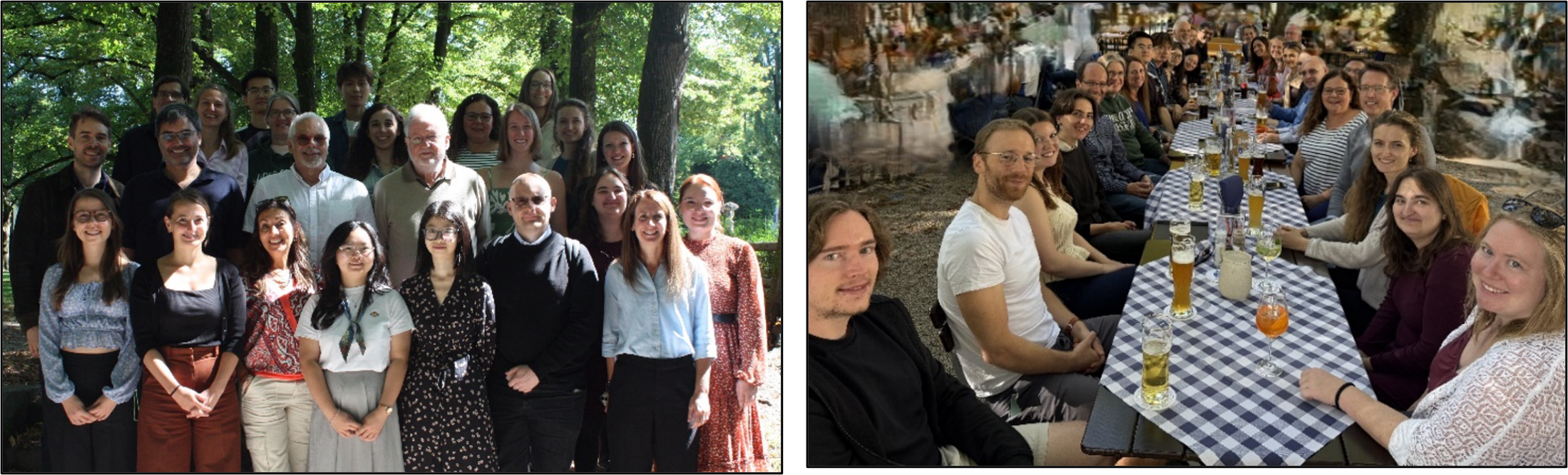
After intensive and successful presentations and discussions, the team said goodbye with a visit to a beer garden, as their time with BEST had come to an end for all those only hired for data collection. The photo shows all BEST members; you might recognize one or two of them.
Neonatal Update 2025
On November 26, 2025, Professor Dieter Wolke presented the latest research findings from the project "Life Course After Very Preterm Birth: Intervention Options" in London to 200 neonatologists, paediatricians, researchers and paediatric nurses from around the world. The event aimed to introduce participants to new scientific areas not necessarily part of their daily work, broaden their horizons, and foster new collaborations. The event was supported by the European Society for Paediatric Research – further information can be found online at: Neonatal Update 2025 | Faculty of Medicine | Imperial College London .
Some of our latest research findings
Brain changes following very early birth are not only highly individual, but also modifiable through our social relationships.
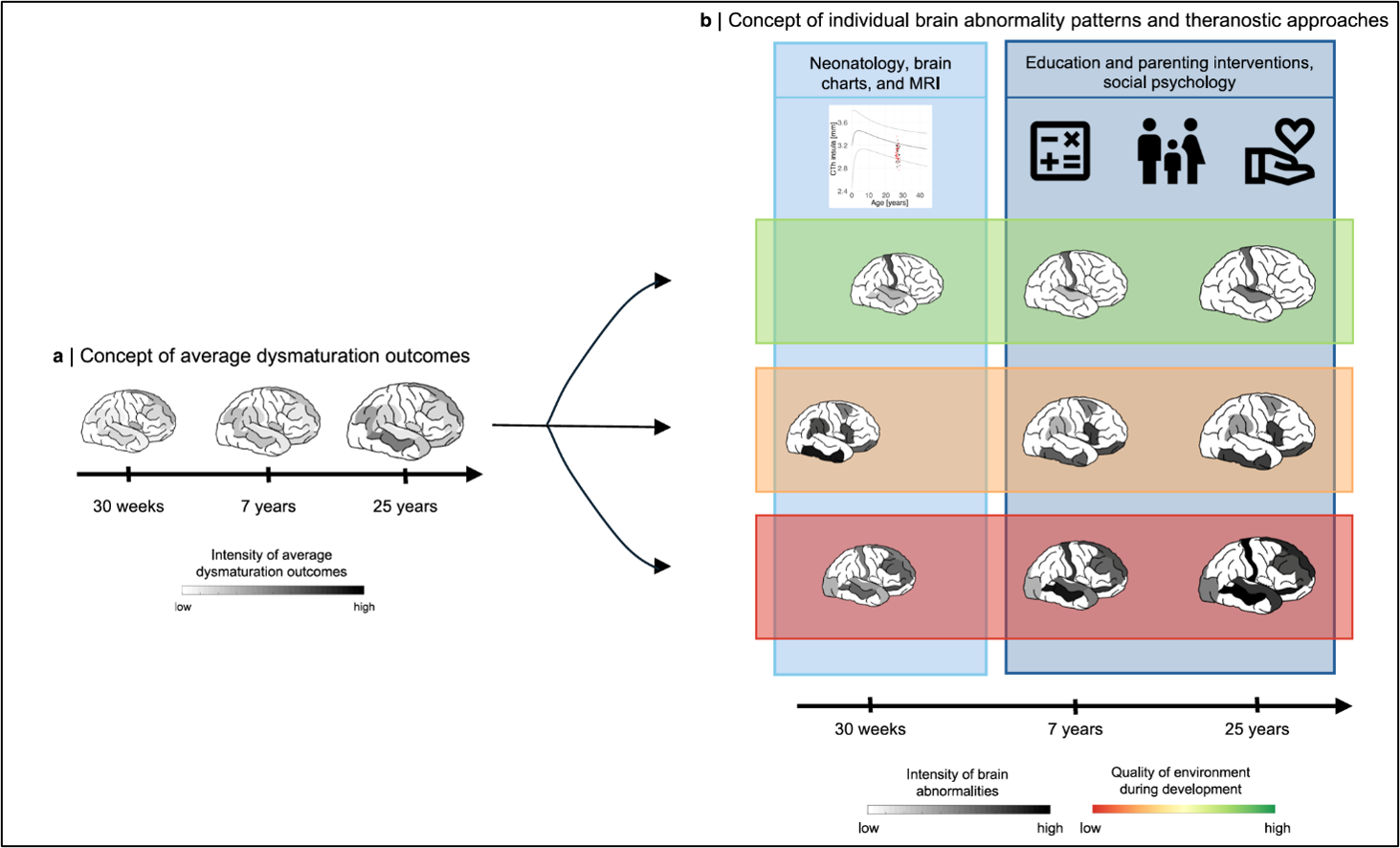
Numerous magnetic resonance imaging (MRI) studies over the past two decades have shown that persistent brain changes can occur after premature birth. These changes are usually triggered by reduced local blood flow and/or oxygen supply at birth. Based on the many previous MRI studies, it was assumed that the brain development of very premature infants follows a typical pattern of brain changes. An example is shown on the left in Figure 1: the pattern of changes in cortical thickness follows premature birth and manifests itself in adolescence and adulthood. These findings give the impression that these changes are similar for all premature infants. At the same time, however, we know from everyday experience and numerous tests that premature infants develop very differently in their brain function – from outstanding to severely impaired – a stark contradiction.
Driven by this contradiction of seemingly stable brain changes and yet differing brain function, we suspected that brain changes following premature birth also vary. However, the commonly used methods of MRI analysis cannot depict these individual differences.
A new way of looking at brain development: similar to growth charts used by paediatricians.
Previous MRI analyses only compared the average values of two groups (very premature infants compared to a full-term control group). However, to identify individual differences, the "growth curve principle" must be used: Instead of just looking at the average, growth curves utilize a very large comparison population (usually over 10,000 people) to understand the distribution of "normal" body weight. These so-called percentile curves then allow us to examine where each individual stands in comparison to the large, age-matched reference group and whether their measurement is within the expected range. For body weight, for example, a weight below the 5th percentile (meaning only 5% of the population has this weight or less) is an indication of relatively low weight, which should be monitored and, if necessary, treated.
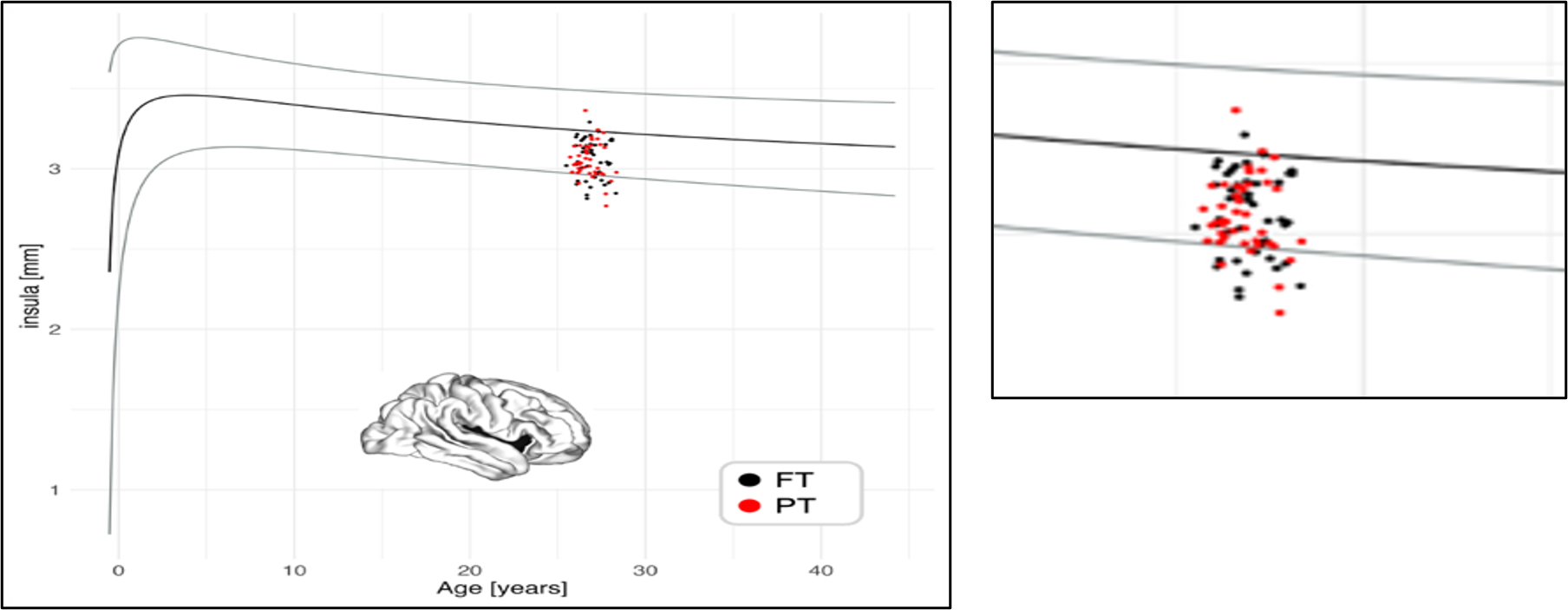
We applied this growth curve principle to brain regions. That is, using more than 100,000 MRI scans of individuals from a representative comparison group spanning from birth to age 100, we determined the distributions (i.e., the growth curves) of the thickness and surface area of cortical regions. Figure 2 shows the distribution of cortical thickness in a selected brain region (the so-called insula) from birth to age 40. The thicker middle line shows the 50th percentile, which corresponds to the mean. The upper and lower lines show the 95th and 5th percentiles, respectively. The dots indicate the positions of individual participants in our Bavarian Developmental Study at age 26 (BEST 4 examination). Black represents a full-term individual, and red a premature individual. You can see that very few individuals fall below the 5th percentile, which would indicate an abnormal position. Furthermore, full-term individuals also fall below the 5th percentile.
Our findings at a glance: Premature infants show highly individual patterns of brain changes.
There is no single, typical pattern that applies to all premature infants. Only about 10–15% of premature individuals fall below the 5th percentile. This observation holds true for all other brain regions, for different measurements such as thickness or surface area of a brain region, and for different ages of newborns, children, and young (BEST 4) and middle-aged (BEST 6) adults. We also found no typical spatial pattern of abnormal cortical changes across all these different age groups. We concluded that brain changes following preterm birth vary considerably in severity and location.
While brain changes remain spatially stable over time (i.e., no new brain changes typically develop after birth, and existing ones do not change location), their severity is influenced by the quality of social relationships (primarily parent-child relationships) – i.e., they are plastic! – an important and encouraging finding. This is illustrated in Figure 1: the brain regions marked in grey to black remain spatially stable for all three examples across the time course from left to right, but the severity changes depending on the better or worse social environment, represented by the coloured environmental boxes.
This leads to two direct diagnostic and therapeutic suggestions for the improved treatment of premature infants after birth and during early development: because of the large differences in brain changes after premature birth, an MRI scan should be performed to assess the risk of further development; because of the positive effect of a good social environment on early brain development, this social environment should be specifically strengthened with social-psychological measures, e.g., regular training sessions for parents, paediatricians, and caregivers.
We believe that further studies of this kind will be needed to improve our treatment options for premature birth.
Your opinion matters
We have already received some feedback regarding this phase of the study for which we thank you. We welcome not only positive feedback but also suggestions on how we can improve communication and the fulfilment of the examination appointments. You can still reach us by email: BEST@ukbonn.de or by phone (with call forwarding and answering machine at +49 228 287-33533).
If you were not contacted during this survey round, this could be because you were not part of the current target group or because we do not have your current contact details. You can help us by informing us directly of any changes to your contact details.
Christmas and the New Year are just around the corner. We wish you and your loved ones a wonderful Christmas, a chance to relax and unwind, and for 2026, that all your wishes and dreams come true. Stay healthy and optimistic, and we would be delighted if you stay connected with BEST.
With kind regards
Prof. Dieter Wolke, Prof. Peter Bartmann, Prof. Christian Sorg, Dr. Barbara Busch
Other newsletters