

Newsletter
December
2023
Dear study participant,
The year is drawing to a close, and we would once again like to inform you about the progress of the Bavarian Longitudinal Study.
First, however, we hope that since spring you have been able to enjoy a return to normal daily life following the end of the coronavirus pandemic. Unfortunately, political developments, growing awareness of the emerging climate crisis, and economic constraints are still causing concern for many of us. This makes us especially grateful that you continue to take an interest in the Bavarian Longitudinal Study and that your participation enables us to continue this important work.
Assessments in Phase VI (also called BEST6@38)
At the start of the new assessment phase, which began in June, we also updated our website (www.bayerische-entwicklungsstudie.de). The website describes the entire history of the study, from its beginning in 1985 to the current phase, BEST6@38. The current research team, working closely across the three study locations in Munich, Bonn, and Warwick, is introduced there. We have also created a short video explaining the steps involved in the new Phase VI assessments. This study is funded by the European Union and has once again been positively reviewed by the ethics committees in Munich and Bonn.
As in previous assessment cycles, the study office is located in Bonn (Prof. Dr. Dr. Peter Bartmann) and is led by Dr. Busch (since 2009). This time, she is supported by Christina Hinrichs and Iris Weyandt. The team in Bonn is responsible for the scheduling appointments, conducting the telephone life course interview and coordinating the collection of saliva samples for genetic analysis.
The onsite assessment once again takes place at the Neuroradiology Clinic at the Klinikum rechts der Isar in Munich. This team is led by PD Dr. Christian Sorg with PD Dr. Dennis Hedderich, PD Dr. Benita Schmitz-Koep, Dr. Marlene Tahedl and Dr. Aurore Menegaux. Together with study assistant Kerstin Maisburger and several medical students, across a half day they conduct a new MRI scan of the head, general physical function assessments and tests of attention, vocabulary knowledge, and problem-solving ability (See also the video on the website: www.bayerische-entwicklungsstudie.de.)
Prof. Dr. Dr. h.c. mult. Dieter Wolke at the University of Warwick (UK) acquired the funding for the study. He is responsible for the overall study leadership as well as implementation and data analysis with his team (Dr. Ahuti Das-Friebel, Kate Evans and Marie Stracke). The team in Warwick has experience in longitudinal analyses and collaborates closely with the Munich group on the analysis of the data.
Thanks to your fantastic support, this phase of the study had a great start. From June until now, over 100 participants have already been reassessed.
We sincerely thank all participants so far!
Your continued interest in the study means a great deal to us, and we hope that all of you will take part in the coming year.
As in previous years, we would like to present some of the findings from the study to you in a brief summary. The first study focuses on pain sensitivity, and the second on body weight regulation.
Pain, fatigue and mental health in adulthood
Many preterm infants have to undergo painful procedures during their early months in neonatal care — experiences that healthy term-born infants do not have to encounter. It is unknown whether such early exposure to pain and stressful events in neonatal care may lead to altered pain perception into adulthood. Do adults born preterm still feel more pain, or have the early experiences “toughened” them, resulting in less reported pain later in life?
Additionally, some adults born very preterm report lower energy levels compared to their term-born peers. In the general population, people with mental health difficulties more often report pain and fatigue. But this raises a “chicken and egg” question: Which comes first?
To investigate these questions, very large sample sizes are required. For this purpose, anonymous data from the Bavarian Longitudinal Study were combined with data from five other cohorts in countries like Finland, Norway, and the UK. In the Bavarian Longitudinal Study, we asked 26 year old participants about their mental health, the severity of any pain or complaints during the past 4 weeks and their level of energy during the past 4 weeks.
Regarding the first question – do early painful experiences affect pain perception in adulthood – we found that Adults born very preterm reported less pain than term-born adults who had only short, routine post birth hospital stays. This suggests that adults born very preterm may be more resilient to pain! On average, adults born very preterm did not report more fatigue than term-born adults. Regardless of birth group, participants who reported more pain and fatigue also had more mental health problems (such as anxiety or depressive symptoms).
These findings suggest that Treatments that reduce pain and fatigue are likely to improve mental health or vice versa.
After preterm birth, a consistently lower body weight is common – a smaller volume of a brain region that is involved in controlling the body weight may contribute to this – the hypothalamus
A lower body weight is common after preterm birth. On average, individuals born preterm tend to remain lighter throughout childhood and even into adulthood — meaning some adults born preterm have a persistently lower body weight compared to the norm. A slightly lower body weight is generally beneficial for health, whereas being overweight increases the risk of certain diseases, e.g., diabetes or high blood pressure. However, the reasons why preterm individuals tend to have persistently lower weight are unclear. Body weight regulation is complex – beside nutrition, certain hormones (e.g., growth hormone), stress, genetic factors, birth weight and eating habits play a role. Within the brain, the hypothalamus, an specifically certain hypothalamic nuclei (see Figure 1), play a role in controlling body weight. For example, some hypothalamic nuclei regulate the production and release of growth hormone or contribute to the control of eating behaviour and eating habits. We know this, because damage to the hypothalamus (e.g. due to bleeding or tumours) leads to changes in appetite and/or body weight.
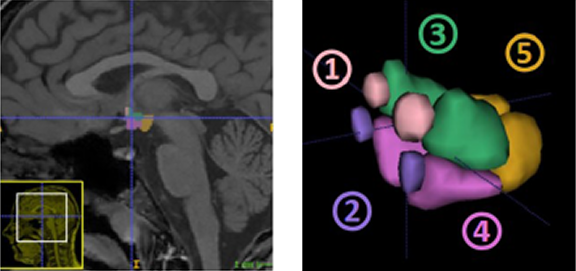
Figure 1: This brain image shows the hypothalamus in an MRI image as seen from the centre of the brain. In the bottom left the corresponding MRI image of the full head and neck is shown for orientation. On the right is a diagram of hypothalamic subregions; for example, subregions 1 and 3 contain nuclei such as the paraventricular nucleus PVN, which are important for body weight regulation.
We examined whether variations in hypothalamus volume might contribute to a reduced long term body weight development among adults born preterm.
Indeed, we found that in preterm born adults participating in the Bavarian Longitudinal Study the hypothalamus as a whole — and particularly the subregions most associated with body weight regulation — were slightly smaller in adults born preterm than in adults born at term (see Figure 2, top left). In line with our expectations, we found that the preterm group showed lower weight gain from birth to 26 years (Figure 2, top right). Interestingly, we then found that this lower weight gain was associated with a smaller hypothalamus volume – for example, the smaller the hypothalamic subregions 1+3 from figure 1, the lower the weight gain from birth to adulthood (see figure 2, bottom left.
In conclusion, those hypothalamus nuclei that play a role in controlling body weight gain are correlated with reduced weight gain – in both directions, too high and too low weight gain across development.
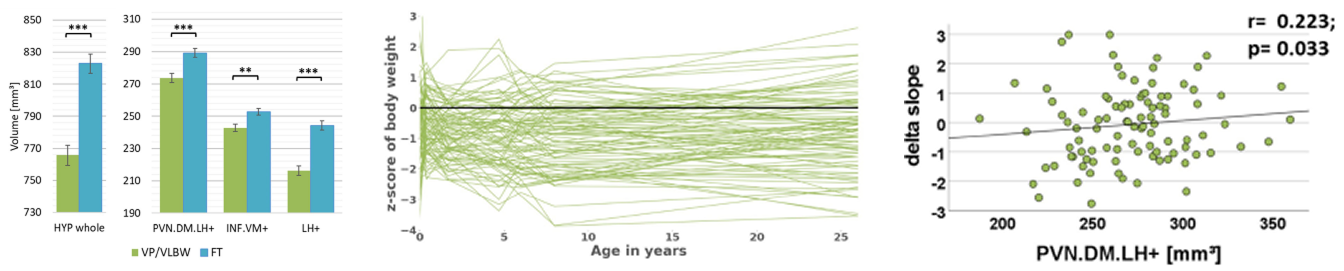
Figure 2. Top left: Smaller volumes of the entire hypothalamus and of substructures that contain nuclei involved in the control of body weight in adults born preterm. Top right: On average, relatively lower bodyweight gain from birth up to the age of 26 years after preterm birth; the zero line represents the typical trajectory for adults born at term – as a relative reference value. Bottom left: The lower bodyweight gain from birth to 26 years (measured as difference values delta) is associated with the smaller hypothalamic volume – the smaller the hypothalamus (specifically substructure 1+3 from Figure 1), the lower the bodyweight gain.
If you would like more detailed explanations or have any other questions, please feel free to contact the study office in Bonn.
To those of you who have already taken part this year — thank you very much. All others will be contacted in 2024, and we hope for your continued participation.
All that remains now is to wish you a merry Christmas season. Given the state of the world this year, taking time for reflection and looking back feels especially important. For 2024, we send you and your loved ones our very best wishes, stay healthy and optimistic. We would be very happy to remain in contact with you.
With kind regards
P.S. Please inform us of any changes to your contact details (address, telephone) via +49 (0)228 / 287 33533 or BEST@ukbonn.de. Thank you!
Other newsletters