

Newsletter
April
2014
End of the assessments
We would like to express a big thankyou to everyone who actively participated in Phase 4 of the BLS!
These are the participation numbers for the assessments
• Participant interview: 521 participants
• MRI examination: 226 participants
• Parent interview: 529 participant parents
To give you a sense of the number of assessments conducted, below is a presentation of the assessment numbers over the entire duration of the data collection phase:

New publications
Effects of gestational age on cognitive performance: A function of workingmemory demands
About 15 million babies, so more than ten percent of all babies worldwide, are born too early every year. We know that some pretermborn children have difficulties in school. Why learning is harder for some pretermborn children has scarcely been researched so far. Using data from our study, we examined how gestational age influences children’s performance on tasks of varying difficulty. Perhaps you remember the mathematics tasks you worked on at age 8? Or the questions about zoo animals? These tasks were more or less complex, depending on how many things you had to consider simultaneously in order to solve them. Examples of test tasks at age 8:
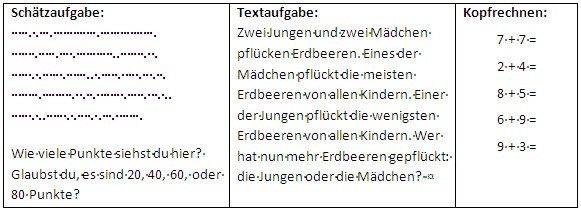

Our results show that performance deficits become greater the more complex the tasks are. This may not be news. However, these differences in performance between easy and complex tasks became increasingly larger the earlier a child had been born. This means that very pretermborn children in particular find it more difficult to solve complex tasks. We recommend that physicians consider these results when planning followup examinations for pretermborn children.
As medical advances have increased the overall number of preterm births, in the future more children will probably need special support in school — this is a major challenge for the school system. One suggestion we make is that teachers could plan lessons so that difficult tasks are broken down into smaller, simpler subtasks for pretermborn children. This could make learning in mathematics lessons easier for pretermborn children and allow them to solve more tasks successfully. There are also new studies that have shown that special computer training programmes, which gradually adjust to the learning ability of each child, can support academic success in pretermborn children.
The association between altered connectivity and grey matter in ventral intrinsic brain networks in pretermborn adults
In our first MRI study the focus was on the question of what the organisation of what are called intrinsic brain networks looks like in pretermborn adults. To understand this question, it is important to know what “intrinsic brain networks” are. Our brain is divided into many different regions that “work together” much like the musicians of an orchestra or the players of a football team. Some of these regions are highly specialised (e.g. for seeing or hearing), while other regions are less specific and combine and process information from different specialised regions. To stay with the example: in a football team there are defenders or strikers who prevent or score goals, while midfield players “mediate” or pass the ball between the two sides of the team.
In order for the different pieces of information processed by the individual brain regions to form an “overall picture” (or “harmonious play”), the various brain regions must interact with each other — that is, exchange information with one another. In this way, functions such as perception, attention, or language become possible at all. This exchange of information between the regions does not occur randomly, but according to specific patterns. Regions that “work together” to a particular degree form a socalled “intrinsic brain network” (these would correspond to the defence, offence, or midfield lines, which taken together form the key units of the entire team).
The organisation of these intrinsic networks represents an essential organisational form of the brain. With the help of functional magnetic resonance imaging (fMRI), it is possible to map this organisation of brain networks. Why the study of intrinsic networks in pretermborn individuals is important arises from the following fact: in a preterm birth, the infant is born at a time when the intrinsic brain networks are just beginning to form and therefore may undergo a slightly altered developmental trajectory. This is the question we wanted to answer.
Our results show that the core organisation of intrinsic networks is not altered by earlier birth. In some networks at the base of the brain (the lower or ventral part of the brain), some networks show altered network function after earlier birth — and always exactly in those places where brain structure is also slightly altered. On the other hand, in the upper part of the brain, other networks are “positively” altered in the sense that the network changes at the brain base are compensated or “balanced”.
This suggests that our brain is capable of compensating for impairments that arise in a particular location very early in development by making adjustments in another location. A better understanding of these adjustments is very important in order to support them further through targeted training. What this might look like more precisely for our attentional performance was the subject of our second MRI study.
The association between altered visual attention and intrinsic brain networks in pretermborn adults
In our second MRI study we examined visual attention performance. For this purpose, some participants completed two computerbased attention tests in which very briefly presented letters had to be identified. Based on this test it is possible to examine different processes of attention separately, such as processing speed or shortterm memory.
Our data show similar performance for the different components of attention in preterm and fulltermborn adults, with slightly reduced performance in pretermborn adults only for the visual shortterm memory store. For the altered shortterm memory we found an association with altered intrinsic brain networks that are important for vision and visual attention. This association between shortterm memory and brain networks is—and this is the important result in our study—of a compensatory nature, i.e. the more the intrinsic brain network deviates from the norm, the better the shortterm memory is.
This is clear evidence of where and how a deficit in visual attention is compensated for by our brain. This result helps to develop highly targeted training methods to improve possible attention impairments caused by preterm birth.
Quality control
The Bavarian Longitudinal Study has undergone a quality control audit by the Coordination Centre for Clinical Studies Düsseldorf (KKSD). These coordination centres, established by the Federal Ministry of Education and Science, ensure that scientific criteria and legal regulations are met in studies.
Ms Janett Schindler carried out what is called an “audit” on behalf of the KKS at all BLS study sites. In this process, workflows, document handling, and data security were reviewed. The results of all audits were positive; the only suggestions for improvement were made in order to optimise workflows.
Team development
The study office in Bonn continues to be available for all participants and parents! Ms Barbara Busch and Mr Christian Koch work there two days a week. If you cannot reach us by telephone, you are welcome to leave a message on the answering machine or send us an email at best@ukb.uni-bonn.de! Since the beginning of the year the team in the study office has become smaller. Claudia Grünzinger successfully completed the parent interviews at the end of December 2013.
The team of our cooperation partners at the Institute for Social Medicine in Paediatrics Augsburg (ISPA) has also been reduced. With the end of the participant interviews in December 2013, our remaining interviewer, Ms Diana Kurze, ended her work for the BLS. The entry of the questionnaires into the computer will be completed by Ms Nikol Dujmovic by spring 2014.
The last MRI appointments took place at the end of January 2014. With this, Prof. Henning Boecker and Marcel Daamen from Bonn and Christian Sorg and Josef Bäuml from Munich ended their employment with the BLS. However, they continue to work on the analysis of the collected data.
In England, Ms Suna EryigitMadzwamuse has completed her work for the study after contributing successfully to publications. Under the direction of one of our project leaders, Prof. Dieter Wolke, Ms Nicole Baumann continues to support us for all data management.
Ms Julia Jäkel from Essen continues to work on data analyses and publications for the study with funding from the German Research Foundation.
Planning of BLS Phase 5
Phase 4 of the BLS will end in 2015 and we are planning another phase! Whether the study can continue seamlessly depends on funding from the Federal Ministry of Education and Science (BMBF). To make this possible, the project leaders prepared and submitted the new application for Phase 5 in autumn 2013. For this, among other things the results from 2009 up to the present had to be presented. The entire team is excited and we very much hope to continue this great study together with you from 2015 onwards!
Tracking and contact maintenance
One of our remaining main tasks is to stay in contact with more than 700 participants and their parents. This can only succeed if we always have uptodate contact details for you! The study office therefore continuously works on maintaining contact with all participants or establishing contact with those participants and parents whom we have not yet been able to contact despite all efforts.
We would therefore like to kindly ask you to also seek contact with us from your side, for example by informing us of your new address after moving, telephone number and email address! Many thanks to the participants who have already notified us of changes! Even if you cannot or do not wish to participate actively in the BLS, maintaining the connection with you is very important to us!
We would especially like to thank all participants and parents who have actively taken part in recent years! It is your study too! Please stay with us!
Warm greetings from the Bonn study office on behalf of the entire BLS team
Prof.Dr. Dr. Peter Bartmann
Dr.Barbara Busch
Dipl.-Soz.Arb. Christian Koch
Other newsletters