

Newsletter
June
2015
New publications
- Neurocognitive performance of adults at age 26 who were born very preterm or with very low birth weight
It is known that children born preterm often have cognitive differences (measured as intelligence quotient, IQ; this includes e.g. perception, attention, and learning) and difficulties with executive (higherorder cognitive) functions (for example, quickly switching between different tasks). Executive functions help guide human behaviour in the context of our complex environment. This includes, for example, setting goals, strategic planning, deciding on priorities, impulse control, and attentional regulation. It is unclear whether these difficulties persist into adulthood.
In our study, IQ and executive functions (EF) of preterm and fulltermborn individuals were examined. In addition, the effects of fetal growth restriction (children who were born with a weight too low for their gestational age) and the family’s socioeconomic status at birth were considered.
Cognitive performance was assessed using several subtests of the Wechsler Intelligence Test (a wellknown standard test). A total IQ score was then determined.
For executive functions, several assessments were conducted. One assessment was the Stroop test (see below). In this test, participants must name the colour in which a word is printed. Reading is usually a very automated process. However, when contradictory information is presented to the brain, it must first be processed. In the Stroop test, for example, the word “red” may be written in green ink. This leads to a delayed response because the colour and meaning of the word do not match. This unfamiliar situation requires increased attention, concentration, and planning.

In another test, the VSAT (Visual Search and Attention Test), the participant was asked to identify a previously shown target letter within a sequence of various other letters. This test can be used to measure visual discrimination ability and attention.

Creative thinking refers to the ability to bypass usual thinking patterns and develop one’s own solutions to problems. This type of thinking can have both positive and negative effects. In companies, this way of thinking is often used in “brainstorming,” that is, in searching for solutions in all possible directions. In everyday life, however, this impulsiveness and tendency to digress can also be very disruptive. One way of testing this is to ask the participant to name as many words as possible from a specific category (e.g. plants).
After evaluating the test results, it became apparent that the overall group of pretermborn individuals (this refers only to the average values of the group, not to each individual person) performed overall worse than fullterm individuals in total IQ and EFs. These difficulties remained unchanged into adulthood. The results also suggested that pretermborn individuals in adulthood were more likely to have multiple cognitive impairments and that these were not restricted to a specific area.
The presence of fetal growth restriction had no effect on the test results. This likely points to the compensatory abilities of the brain, which, after insufficient supply during pregnancy, can make up for deficits after birth. Thus, adults may have “grown out of” problems associated with fetal growth restriction in terms of cognitive performance that were limited only to childhood. This is a very positive result.
Overall, the problems found by other study groups were confirmed. Abilities such as cognitive flexibility, impulse inhibition, visual discrimination, attention, verbal fluency, and processing speed are often altered in pretermborn individuals. However, the differences in these areas were less pronounced than in the total IQ. During the assessments at age 6, we were already able to show that pretermborn children particularly have deficits in processing information presented simultaneously, that is, in managing complex tasks.
Family socioeconomic status (SES) had a very strong effect on total IQ. This was seen in both preterm and fulltermborn individuals even into adulthood. However, the risk of having a lower total IQ was twice as high for pretermborn individuals as for fullterm individuals. A high SES can have a compensatory effect on total IQ. This means that children in families with high SES achieve overall better IQ scores. Nevertheless, the total IQ of pretermborn individuals with high SES was still in the same range as that of fullterm individuals with low SES.
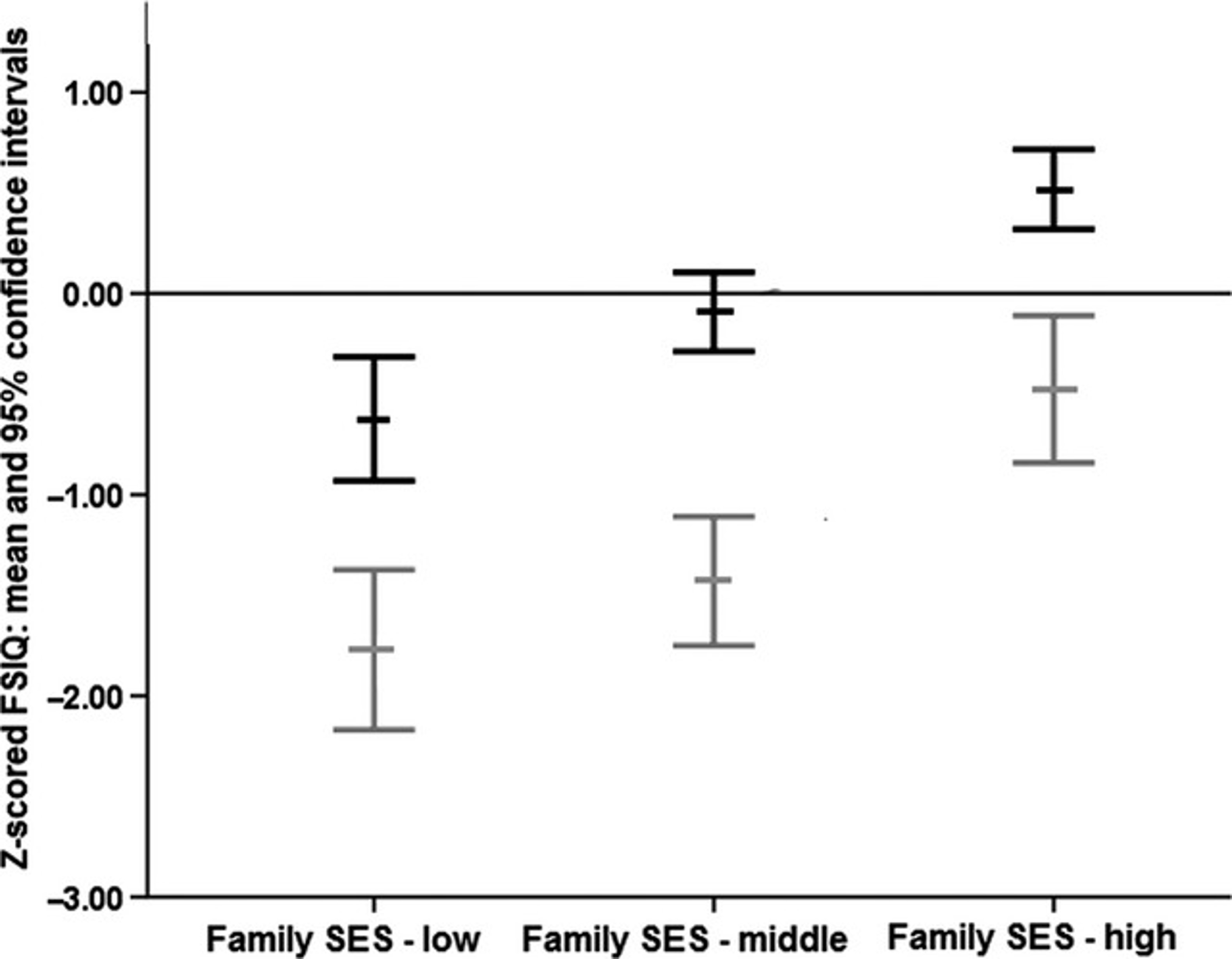
Grey = Pretermborn Black = Fulltermborn
The results for pretermborn individuals with high SES and fulltermborn individuals with low SES are approximately at the same level.
This effect was even more pronounced in adulthood than in childhood, which is likely explained by cumulative effects of parenting, family circumstances, and access to educational opportunities throughout the entire lifespan. Different effects during life add up over time. Thus, low IQ scores in childhood become further worsened in adults who grow up in a family with low SES.
2. Workingmemory performance in pretermborn adults: compensatory activity of the “default mode network” with increasing cognitive load
Earlier studies have shown that pretermborn individuals demonstrate reduced workingmemory performance compared to fulltermborn individuals. Working memory refers to the part of human memory responsible for the temporary storage and manipulation of information. The reduced workingmemory performance of pretermborn individuals may also be associated with altered brain activity. In the present study, we therefore examined the workingmemory performance of 73 preterm and 73 fulltermborn adults at varying levels of task difficulty while they were lying in the magnetic resonance imaging scanner (MRI). The participants were shown various letters on a screen one after another (e.g. “M – X – L – F – F – ...”). The experiment was divided into three task conditions, which were repeated several times. In the first condition (called “0Back”), the task for the participants was to press a button with their index finger whenever the letter “X” appeared on the screen.
In the second condition (called “1Back”), participants were to respond when the letter shown on the screen was identical to the previous one (e.g. “F – F [>> press <<]”).
In the third condition (called “2Back”), participants had to press the button when the presented letter was identical to the one shown two positions earlier (e.g. “C – S – C [>> press <<]”).

The different blocks therefore differed in difficulty, with the “2Back” condition being the “hardest,” since the last two letters constantly had to be kept in mind. Both groups — preterm and fulltermborn adults — mastered the task equally well. This is a surprisingly positive result which we were pleased to find. Moreover, both groups activated similar brain areas while completing the task. However, it was striking that in the most difficult condition (“2Back”), the pretermborn adults “deactivated” certain brain regions that belong to the socalled “default mode network” (DMN) more strongly than the fullterm adults. The DMN is usually characterised by being more active during rest (i.e. when letting one’s thoughts wander) than in situations where we must focus our concentration on external stimuli (i.e. when completing a demanding task). In this sense, it is assumed that the human brain temporarily “downregulates” the DMN regions (and the freeflowing thought processes occurring there) in order to better concentrate on the task at hand. The fact that pretermborn individuals deactivated these regions more strongly as the task became more difficult — while achieving performance equal to that of the fullterm adults — is interpreted by us as a compensatory function of the brain.
In summary, it can therefore be stated that preterm and fulltermborn adults activate similar brain regions during a workingmemory task (with the same performance). The stronger deactivation of DMNassociated regions during the most difficult condition may be a mechanism of the preterm brain for mastering the increasing task difficulty. We would like to investigate this in more detail in the future.

This graphic shows brain regions (left graphic, yellow areas in the brain) that pretermborn individuals (VP/VLBW) deactivated more strongly during the “2Back” condition compared to the fulltermborn individuals (Controls).
Quality control
The Bavarian Longitudinal Study has received audit certificates for all four study sites from the Coordination Centre for Clinical Studies Düsseldorf (KKSD).
In the study office in Bonn, this included review of the ethics application, study documents and insurance documents, control of compliance with data protection regulations, and contractual agreements with the study partners in Bonn, Augsburg, and Munich. For the Augsburg study site, processes and structures of the participant interviews and data quality checks were reviewed in addition to data management. In the two MRI centres in Bonn and Munich, particular attention was paid to checking and documenting the medical suitability of participants as well as the safety and monitoring of the examination room.
The additions recommended by the KKS Düsseldorf were implemented, and thus the four certificates could be issued to us without reservations. This means that the study has been conducted according to the highest scientific quality standards, as verified by an independent institute.
Team development
The study office in Bonn continues to be staffed by Dr. Barbara Busch and Mr. Christian Koch. We are in the office on two days of the week. If you cannot reach us by phone, you are welcome to leave a message on the answering machine or send us an email at best@ukb.uni-bonn.de!
Further followup assessments
Unfortunately, the application we submitted to the Federal Ministry of Education and Science (BMBF) to extend the study for another six years was not approved. This initially disappointed us greatly, as we had already begun preparations for another assessment phase. Nevertheless, this does not mean the end of the study!
We are very pleased that, with our longstanding colleague Dr. Dipl. Psych. Gabi Schmid, we can carry out a new series of assessments in Munich. This substudy focuses on the socalled “moderately preterm” infants. The usual duration of pregnancy is 37–42 weeks. In our previous assessments, alongside the control participants born within this period, we examined the group of preterm participants. These participants had been born before 32 weeks of gestation or with a birth weight under 1500 g. These children have a very high risk for health problems and developmental disorders.
The group of socalled “moderately preterm” infants includes all children born between 32 and 36 weeks of gestation. These children often have only minor health problems after birth and in further development, but compared to very preterm children, far more of them are born. For this reason, it is particularly important to study this group of preterm infants as well.
The new assessments have been running since the end of March and include, as before, a psychological interview and, if the participant is willing, also an MRI scan.
Tracking and contact maintenance
One of our remaining main tasks is to stay in contact with you — the more than 1100 participants of the study — and your parents. This can only succeed if we always have uptodate contact details for you. We therefore continuously work on maintaining contact with you or establishing contact with those participants and parents whom we have not yet been able to contact despite all efforts. Therefore, we would like to kindly ask you to also seek contact with us from your side — for example, by informing us of your new address, telephone number, or email address. Many thanks to those of you who have already independently notified us of changes! Even if you cannot or do not wish to participate actively in the BLS, maintaining the connection with you is very important to us.
Warm greetings from the Bonn study office on behalf of the entire BLS team.
Prof.Dr. Dr. PeterBartmann Dr. Barbara Busch Dipl.-Soz. Arb. Christian Koch.
Other newsletters