
The Study


Phase 6@38
In June 2023 we launched Phase 6 of the Bavarian Longitudinal Study. This project is supported by the European Research Council through the United Kingdom's Research & Innovation program.
Our main objective is to understand how genetics and the social environment, from birth onward, combine to influence people's physical and social health. Are the mechanisms the same for adults born very prematurely (<32 weeks gestation) or with a very low birth weight (<1500g) and for adults born at term? We are particularly interested to discover what contributes to improving lives and health, and slowing the aging process. A key concern is understanding how people approach and overcome challenges and difficulties in adulthood.
In this Phase our data collection focuses on physical health, life course and social relationships. Two centers are conducting the examinations:
The Team at the University Hospital Bonn (led by Prof. Dr. Dr. Peter Bartmann) is conducting a telephone-based life course interview and collecting saliva samples using kits sent to participants' homes.
At the Technical University of Munich (led by Prof. Dr. Christian Sorg) on-site examinations are taking place focusing on three areas:
- Physiological examinations including a step test, height and weight measurements, a breathing test, and the collection of a small blood sample.
- Cognitive assessments include tests of attention and problem-solving skills.
- MRI scan of the head is being performed (as at 26 in Phase 4 BEST)
The study is still being led by Pinciple Investigator, Prof. Dr. Dr. hc. Dieter Wolke at the University of Warwick in the UK.
For an overview of the research methods at c 38 years, please see this short video.
Data collection was completed in September 2025:
436 Participants completed the telephone interview
299 Participants completed the examination at the TU Munich
351 Saliva samples have now been collected and analysed
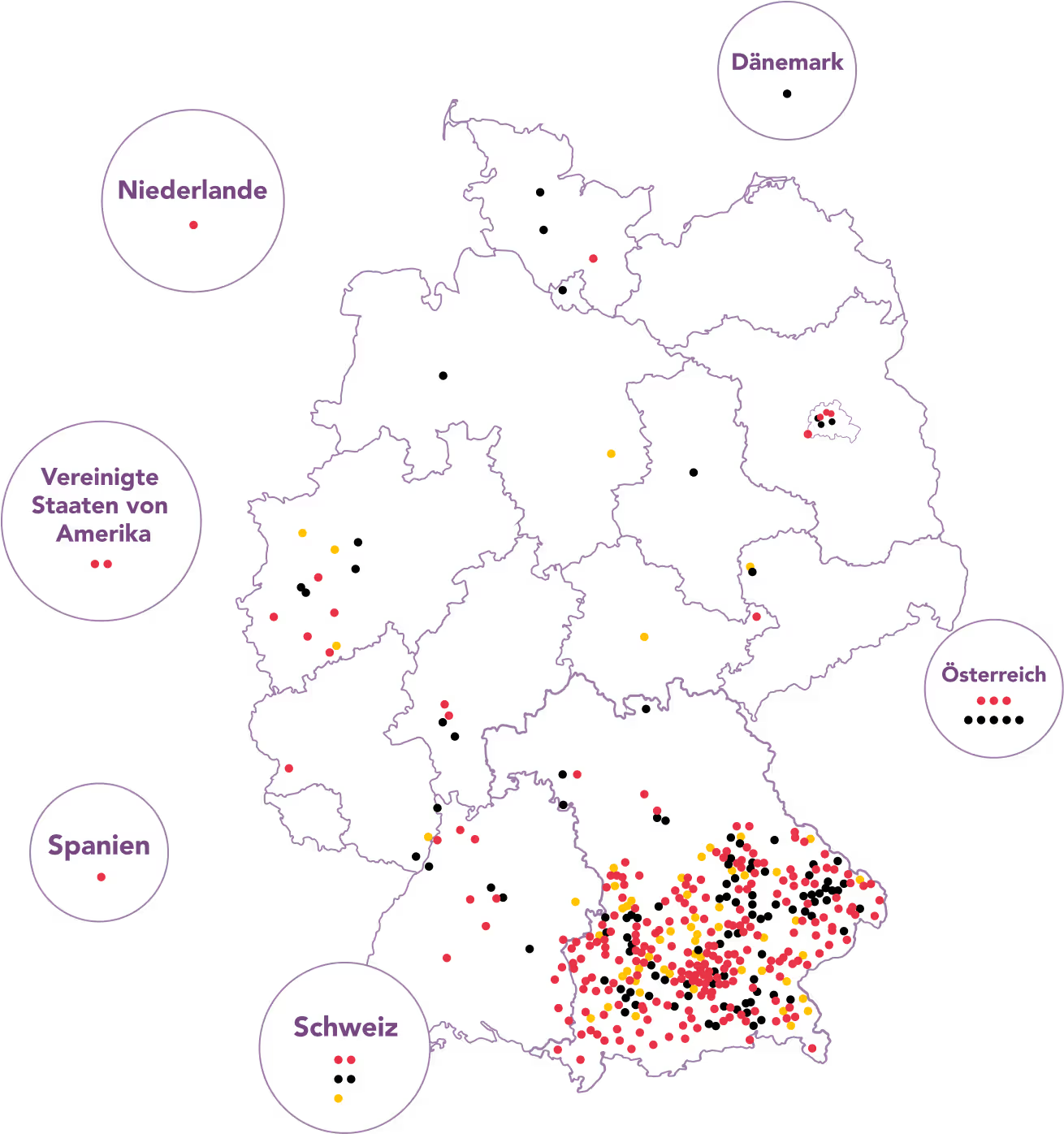
Verteilung unserer Teilnehmer*innen im Jahr 2023

Premature infants (<32 weeks gestation) or low birth weight infants (<1500 g);n=385

Control group (>37 weeks of gestation); n=275

Index group (32-37 weeks of pregnancy); n=133

104 = no participant data

Phase 5
The aim was to investigate social and professional adjustment in adulthood. The main question was whether those born very prematurely (<32 weeks of gestation) or underweight (<1500g at birth) are similarly satisfied, show the same integration into working life, have similar social relationships with friends, parents and partners and start their own families in the same way as those born at term or normal weight. The study also examined what helped the adults overcome difficult situations.
This study was part of a project comprising a total of 34 studies of premature and full-term infants from 14 European countries. The survey was divided into two parts: a telephone interview of c 30 minutes and an online survey of c 15 minutes.
Phase 5 was completed in March 2022.
We were able to re-interview almost 60% of the study participants.
417 Telephone interviews
323 Online questionnaires

Phase 4
The main objective of this phase was to re-examine the group of high-risk premature infants (born <32 weeks of gestation or with a birth weight <1500 grams) and the control group of the Bavarian Longitudinal Study at ages 23–26. These same individuals had already been examined as newborns and subsequently at six other time points, most recently at ages 12–13 (see Phases 1–3).
The central question was which risk factors, protective factors, and adaptive strategies influence cognitive development, behaviour and quality of life. The data helped to paint a picture of how children develop up to the age of 8.5 years, depending on the duration of pregnancy, from very premature to full-term. The results showed that social factors, which can be influenced through support or encouragement, particularly promote positive development in moderately premature infants. The findings were compared with three large international studies (Millennium Cohort and EPICure in England, POPS in the Netherlands) to confirm their reliability.
In addition MRI scans of the brain were performed. The aim was to identify typical deviations in brain activity in specific subgroups, for example, during attention network tasks. Novel, data-driven MRI methods were correlated with clinical, behavioural and developmental data.
In line with the funding objective, the study was expanded at this stage to address key questions regarding the health and development of very low birth weight infants.
In Phase 4 from 23 September 2010 to 31 December 2013:
521 People participated in the psychological interview
226 People participated in MRI scans
529 Parents participated in the telephone parent interview.

Phase 3
In Phase 3, at the age of 12 or 13, data was collected using postal questionnaires. Only children born < 32 weeks of gestation or weighing < 1500g, and an equal number of full-term infants, could be followed up. The questionnaires covered children's behaviour, health and quality of life, social circumstances and how the children felt. The survey took place between August/September 1998 and May 1999.
671 Participants completed the study

Phase 2
In Phase 2 approximately 1,500 children and their parents underwent further examinations. The assessments, conducted at 6 years 3 months and 8 years 5 months, focused on the periods before and after school enrolment. During these assessments the children and their parents were interviewed about their living conditions and family circumstances. The children also underwent a full-day evaluation in the areas of language, mathematics, intelligence, behaviour and school adaptation. In addition, they received physical and neurological examinations.
1502 Participants completed the study

Phase 1
All children born between 1 January 1985 and 31 March 1986 who required admission to a children's hospital in southern Bavaria within the first ten days of life were asked to participate in the study. Nearly all parents of these children participated in the BEST study. A total of 16 Children's Hospitals with Neonatal Units from the administrative districts of Upper Bavaria, Lower Bavaria, Swabia and the southern half of the Upper Palatinate were involved.
During the recruitment period a total of 7505 newborns admitted to the participating children's hospitals were documented. Of these 682 children were born < 32 weeks of gestation or weighing < 1500 grams at birth.
Newborns from neighboring obstetric departments who were not transferred to the study were recruited as control infants. A total of 916 non-transferred newborns were included in the study as control infants.
The children and their parents were examined during the neonatal period and at 5, 20, and 56 months of age.
These examinations included questions about pregnancy, childbirth, family and living conditions. Clinical, neurologicaland cognitive status, as well as behavior, were also assessed.
8421 Participants completed the examination

With Thanks
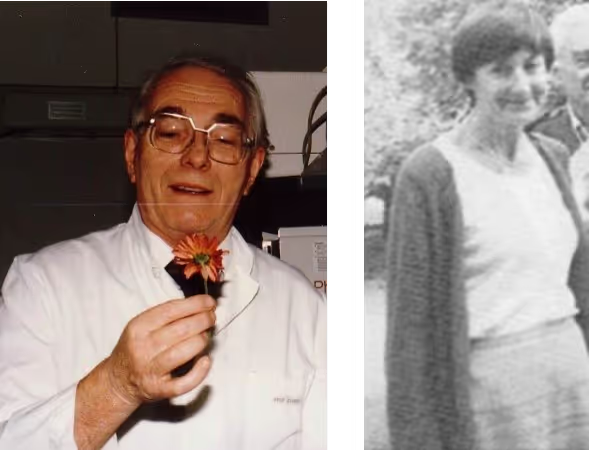
We extend our heartfelt thanks to Professor Klaus P Riegel and Barbara Ohrt for their invaluable contributions to the Bavarian Longitudinal Study. Professor Riegel's groundbreaking vision and tireless dedication laid the foundations for this work and shaped perinatal medicine far beyond Bavaria. Barbara Ohrt supported the study for many years with commitment, expertise and meticulous care.
Her legacy lives on in the study's success and in the lives it continues to improve.